What Is in Memodyne? Ingredients and Amounts per Capsule
Quick answerEach Memodyne capsule lists seven ingredients, and every amount is printed.
The lines are L-arginine 200 mg, L-arginine AKG 200 mg, L-citrulline HCl 100 mg, L-citrulline malate 100 mg, beta-alanine 40 mg, niacin 7.5 mg NE and calcium 18 mg, with no hidden blend.
Curious how they fit together? See how Memodyne works.
- 60-day satisfaction window
- Free US shipping on 3 and 6 bottles
What are the seven lines on the Memodyne label?
The Supplement Facts panel prints seven ingredient lines. Five are amino acids. One is a B vitamin and one is a mineral. Tap any card to read more about that line.
 Amino acid
L-Arginine (base)
Free-form arginine200 mg per capsuleThe body uses arginine to make nitric oxide, which widens blood vessels. Blood pressure trials used 4 to 24 g a day.About L-Arginine (base) on the ingredients page02Amino acid saltL-Arginine AKG 2:1 Extract
Arginine bound to alpha-ketoglutarate200 mg per capsuleA sports-supplement form of arginine. Part of the 200 mg is the alpha-ketoglutarate carrier, not arginine.About L-Arginine AKG 2:1 on the ingredients page03 Amino acid
L-Citrulline HCl
Citrulline hydrochloride100 mg per capsuleThe body turns citrulline into arginine. Studies used gram doses; 100 mg is a small fraction of that.About L-Citrulline HCl on the ingredients page04Amino acid saltL-Citrulline Malate
Citrulline bound to malic acid100 mg per capsuleCitrulline joined to malic acid, the form sold in workout powders. Part of the weight is the malate.About L-Citrulline Malate on the ingredients page05Amino acidBeta Alanine
Amino acid used in sports formulas40 mg per capsuleSports studies used 4 to 6 g a day, where tingling skin is the known side effect. 40 mg is about 1% of 4 g.Read the full Beta Alanine page06B vitaminNiacin
Vitamin B3, 7.5 mg NE7.5 mg NE per capsuleA B vitamin. 7.5 mg NE is about half of what adults need each day, well under the 35 mg upper limit.Read the full Niacin page07 Mineral
Calcium
As calcium carbonate18 mg per capsule18 mg is a small amount: adults need 1,000 to 1,200 mg a day, mostly from food.About Calcium on the ingredients pageEach line has its own amount, so there is no proprietary blend. That is a real plus. Our Supplement Facts page retypes the full panel so you can read it in large print.
How do the 640 mg of amino acids add up?
- L-Arginine (base) 200 mg
- L-Arginine AKG 2:1 Extract 200 mg
- L-Citrulline HCl 100 mg
- L-Citrulline Malate 100 mg
- Beta Alanine 40 mg
- Niacin 7.5 mg NE
- Calcium 18 mg
The five amino acid lines add up to 640 mg per capsule. Arginine makes up 400 mg of that, split across two forms. Citrulline adds 200 mg, also in two forms. Beta-alanine is the smallest amino acid line at 40 mg.
Does the brand graphic match the label?
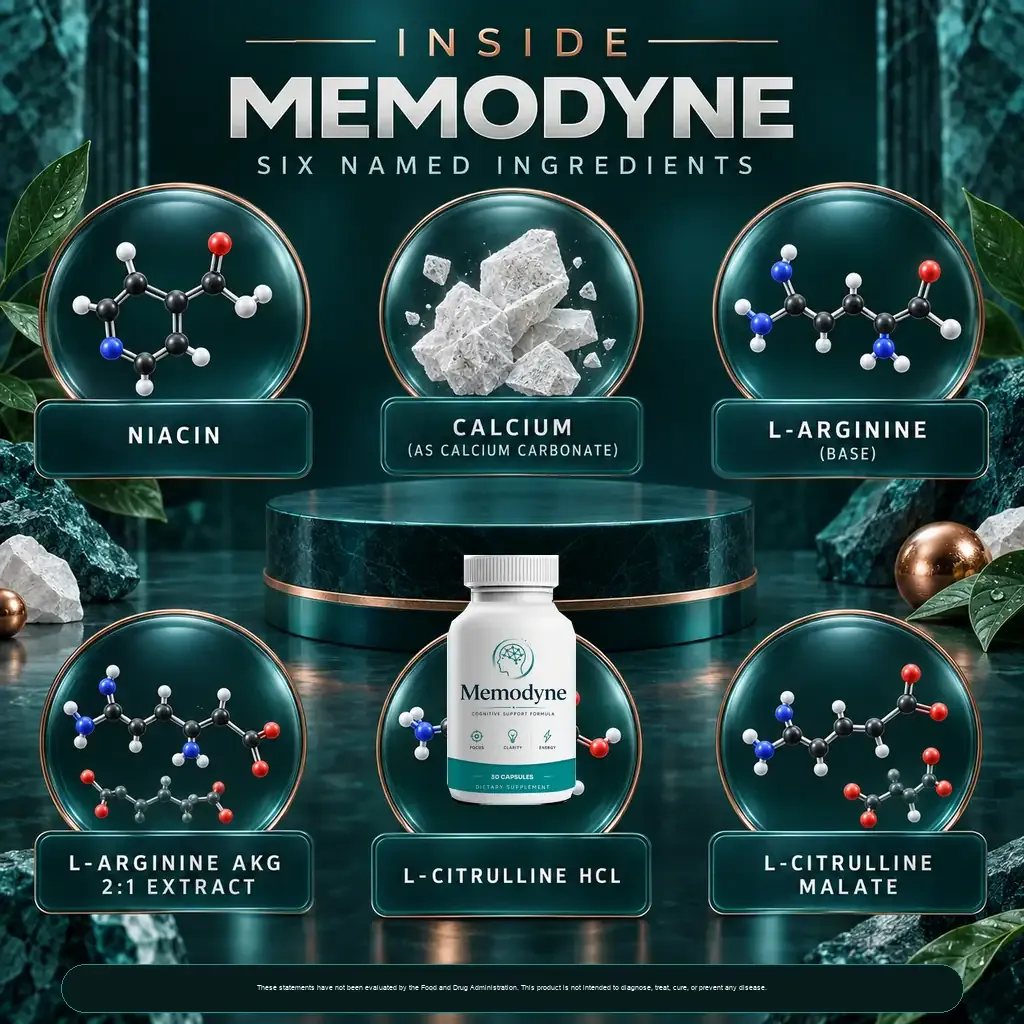
Not quite. The brand's “Inside” graphic names niacin, calcium, two arginine forms and two citrulline forms. It leaves out beta-alanine.
The Supplement Facts panel on the bottle prints beta-alanine at 40 mg. When a graphic and a label disagree, the label wins. So on this site we say the label lists seven lines.
L-arginine: why does the label list two forms?
The label lists 200 mg of plain L-arginine and 200 mg of L-arginine AKG. Both supply arginine, an amino acid found in meat, fish, dairy, nuts and beans. The body uses arginine to make nitric oxide, a gas that helps blood vessels relax (Schwedhelm et al., 2008).
The plain form, called the base, is free arginine. In blood pressure trials, people took 4 to 24 g a day. One capsule's 200 mg of base is about 1% to 5% of that range.
L-Arginine AKG 2:1 Extract
AKG stands for alpha-ketoglutarate. It is a carrier joined to arginine, and it is common in sports products. One study gave trained men 12 g a day for 8 weeks (Campbell et al., 2006).
Part of the 200 mg is the AKG carrier, not arginine. So the true arginine total per capsule is a bit under 400 mg. Read the full L-arginine page for the research and the safety notes.
L-citrulline: what do the HCl and malate forms add?
The label lists 100 mg of L-citrulline HCl and 100 mg of L-citrulline malate. Citrulline is an amino acid named after the watermelon. The body turns it into arginine, mostly in the kidneys. One study found oral citrulline raised blood arginine more efficiently than the same amount of arginine (Schwedhelm et al., 2008).
HCl means hydrochloride, a salt form that dissolves easily. It adds a small amount of weight that is not citrulline.
L-Citrulline Malate
The malate form joins citrulline to malic acid, the sour acid in apples. Workout powders often use it. Part of the 100 mg is malate, so the citrulline in it is less than 100 mg.
Trials of citrulline used gram doses, and the results vary (Khalaf et al., 2019). The L-citrulline page explains how it links to arginine.
Beta-alanine: why is a sports ingredient on the label?
Beta-alanine is an amino acid sold for exercise. Muscles use it to build carnosine, which helps buffer acid during hard effort. Sports studies used 4 to 6 g a day for at least two weeks (Trexler et al., ISSN 2015).
The known side effect is a pins-and-needles tingle on the skin. With 40 mg per capsule, that tingle is unlikely. Forty mg is about 1% of the low end of the studied range.
The label does not say why it is included. More detail is on the beta-alanine page.
Niacin: how much vitamin B3 is in one capsule?
One capsule lists 7.5 mg NE of niacin, which is 47% of the Daily Value. Adult men need about 16 mg NE a day and women about 14 mg NE (NIH ODS, Niacin). So one capsule covers roughly half a day's need.
NE means niacin equivalents. It counts niacin from all sources in one unit. The upper limit from supplements is 35 mg a day. Skin flushing tends to start around 30 mg of nicotinic acid, so 7.5 mg is well below that range.
If you already take a B-complex or a multivitamin, add up the niacin on both labels. The niacin page shows how.
Calcium: is 18 mg enough to matter?
No, not for daily needs. Adults need 1,000 to 1,200 mg of calcium a day (NIH ODS, Calcium). The 18 mg in one capsule is under 2% of that, and the label shows it as 1.5% of the Daily Value.
The form is calcium carbonate, the same type used in many antacids. At this small amount it is unlikely to matter for bone health.
How do the label amounts compare with the doses in studies?
| Ingredient | Memodyne (per serving) | Doses used in studies | Gap | Source |
|---|---|---|---|---|
| L-Arginine | 400 mg listed (200 mg base + 200 mg AKG form) | 1.66 g twice a day in a small memory trial; 4-24 g a day in blood pressure trials | About 12% of the 3.3 g memory-trial dose | (Mone et al., 2022) |
| L-Citrulline | 200 mg listed (100 mg HCl + 100 mg malate) | Gram doses in blood pressure trials | A small fraction | (Khalaf et al., 2019) |
| Beta Alanine | 40 mg | 4-6 g a day in sports studies | About 1% of 4 g | (Trexler et al., ISSN 2015) |
| Niacin | 7.5 mg NE | Adults need 14-16 mg NE a day | About half a day's need | (NIH ODS, Niacin) |
| Calcium | 18 mg | Adults need 1,000-1,200 mg a day | Under 2% | (NIH ODS, Calcium) |
Every amount is smaller than the doses researchers tested. A smaller dose is not proof that nothing happens. It does mean the studies do not tell us what this dose does.
Our how it works page explains the blood-flow idea behind the formula in more detail.
What are the other ingredients for?
| Other ingredient | Job | What it is |
|---|---|---|
| Hypromellose (Vegetable Capsule) | The capsule shell | A plant-based cellulose material, used instead of gelatin |
| Vegetable Stearate | Flow aid | Helps the powder move smoothly through the filling machine |
| Silicon Dioxide | Anti-caking agent | Keeps the powder dry and loose |
These three are standard in capsule supplements. The label lists no sugar, no gelatin, no dyes and no caffeine.
Who should check these ingredients with a doctor first?
Blood pressure and heart medicine
Arginine and citrulline may lower blood pressure. They can add to blood pressure drugs, nitrates like nitroglycerin, and ED pills like sildenafil (Mayo Clinic, L-arginine) (WebMD, L-citrulline). In a trial after heart attacks, arginine did not help and more deaths occurred in the arginine group (Schulman et al., JAMA 2006).
Bring the label to your doctor or pharmacist if
- You take any blood pressure medicine
- You use nitroglycerin or another nitrate for chest pain
- You use an ED pill, for example sildenafil or tadalafil
- You have had a heart attack or have heart disease
- You are pregnant, nursing or under 18, as the label says
- You already take a B-complex or multivitamin with niacin
Our side effects page covers what to watch for in the first weeks.
Honest note: is this a memory formula?
The label calls it a “Cognitive Support Formula,” but the ingredients are the ones sold in nitric oxide and workout products. Blood flow does matter to the brain. Still, no study of Memodyne has been published.
One small trial gave frail older adults with high blood pressure 3.3 g of arginine a day for four weeks (Mone et al., 2022). Their thinking-test scores differed from placebo. It was small, short and single-blind, and the dose was about eight times what one capsule lists.
Supplements are not proven to prevent dementia (NCCIH, Supplements for cognitive function). Sleep, activity, blood pressure control and a check of B12 and medicines have stronger support. Our brain health basics guide covers those habits.
Memodyne ingredients FAQ: questions people ask
What are the ingredients in Memodyne?
The label lists seven lines: L-arginine (base) 200 mg, L-arginine AKG 2:1 200 mg, L-citrulline HCl 100 mg, L-citrulline malate 100 mg, beta-alanine 40 mg, niacin 7.5 mg NE and calcium 18 mg. The capsule is made of hypromellose, with vegetable stearate and silicon dioxide.
Does Memodyne have a proprietary blend?
No. Every line on the Supplement Facts panel has its own printed amount. You can see exactly how much of each ingredient one capsule holds.
How much L-arginine is in Memodyne?
One capsule lists 400 mg in two forms: 200 mg of plain L-arginine and 200 mg of L-arginine AKG. Part of the AKG form's weight is the carrier, so the true arginine total is a bit under 400 mg.
What is L-arginine AKG?
It is arginine bonded to alpha-ketoglutarate, a compound the body uses to make energy. It is a common form in sports and workout products.
Why is beta-alanine in a memory supplement?
The brand does not explain it. Beta-alanine is a sports ingredient studied for muscle endurance at 4 to 6 g a day, and the 40 mg here is about 1% of the low end.
Will the beta-alanine in Memodyne make my skin tingle?
Tingling is unlikely at 40 mg. In sports studies it shows up with single doses in the gram range, which is many times more than one capsule holds.
Can the niacin in Memodyne cause flushing?
It is unlikely. Flushing tends to start around 30 mg of nicotinic acid, and one capsule lists 7.5 mg NE, about a quarter of that.
Is the Memodyne capsule vegetarian?
The capsule shell is hypromellose, a plant-based material, and the stearate is listed as vegetable. The label does not carry a vegan or vegetarian seal, so ask the order desk if you need certainty.
Why does the brand's ingredient picture show only six items?
The brand graphic leaves out beta-alanine. The Supplement Facts panel prints it at 40 mg, and the panel is the one to trust.
Ready to try Memodyne?
One capsule a day, 30 per bottle, from $49 a bottle on the 6-bottle pack, with a 60-day money-back window shown on the sales page. Take blood pressure or heart medicine? Ask your doctor first.