
Memodyne Side Effects: What to Watch For in the First Two Weeks
Quick answerMemodyne side effects have not been measured in any published study of the capsule, so what is known comes from its single ingredients. Dizziness from lower blood pressure is the main worry, and stomach upset is possible. Flushing and tingling are unlikely at these amounts. Six checks and a short log for the first two weeks help you spot trouble early.
What are the key facts about Memodyne side effects?
Key facts
- No side effect data on Memodyne itself has been published. What we know comes from its single ingredients.
- The main concern is blood pressure. Arginine and citrulline may lower it, and may add to blood pressure drugs, nitrates and ED pills.
- Stomach upset is possible. Larger arginine doses are linked to stomach pain, bloating and loose stools.
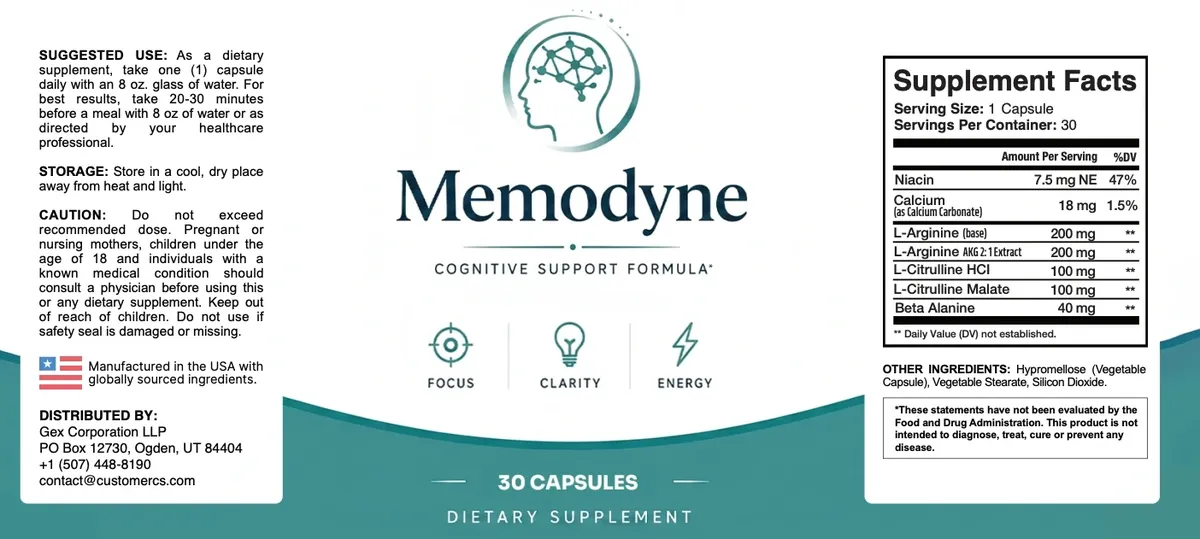
- Niacin flushing starts around 30 mg of nicotinic acid, and one capsule lists 7.5 mg NE. Beta-alanine tingling is seen at 4 to 6 g a day, and one capsule lists 40 mg.
- After a heart attack, an arginine trial found no benefit and more deaths in the arginine group.
- Stop and call your doctor if you feel dizzy, faint or unwell. Call 911 for stroke signs.
Why keep a log for the first two weeks?
Because early signs are easy to forget. A little dizziness on day three can slip your mind by day ten. Notes turn a vague feeling into something your doctor can use.
We also use two weeks because it is short and practical. Nothing in our sources says the first fortnight is special. It is simply a good window to watch closely, when everything about the routine is new.
What are the 6 checks?
- 01
Check your health and medicines first
Before capsule one, not after.
- 02
Watch for low blood pressure
Dizziness, tiredness, faintness.
- 03
Watch your stomach
Upset is possible; the label says take it before food.
- 04
Know flushing and tingling are unlikely
But note them if they appear.
- 05
Write a short log
Four lines a day is plenty.
- 06
Know your stop signs and emergencies
Stop, call, report.
Who should check with a doctor before the first capsule?
| If you take or have | What the source says | What to do |
|---|---|---|
| Blood pressure drugs | Arginine can lower blood pressure, so the mix may not be safe (MSKCC, Arginine) | Ask your doctor first |
| Nitrates, such as nitroglycerin | Blood pressure might drop too low (Mayo Clinic, L-arginine) | Ask your doctor first |
| ED pills, such as sildenafil | Blood pressure might drop too low (Mayo Clinic, L-arginine) (WebMD, L-citrulline) | Ask your doctor first |
| A past heart attack | No benefit and more deaths with arginine in one trial (Schulman et al., JAMA 2006) | Ask your cardiologist first |
| Pregnant, nursing, under 18, or a known condition | The label says to consult a physician first | Ask your physician first |
Never stop or change a prescription because of a supplement. Bring the bottle or a photo of the label to your doctor or pharmacist, so they can read all seven lines.
What are the signs of blood pressure dropping too low?
Dizziness and lightheadedness come first, especially when you stand up fast. Some people also feel unusually tired, see blurred vision or feel faint.
If you notice these signs
- Sit or lie down at once.
- Stop taking the capsules and phone your doctor.
- Stand up slowly in future, and hold a rail or chair.
- If you faint or have chest pain, call 911.
The capsule holds 400 mg of arginine and 200 mg of citrulline, small amounts next to trial doses. Small is not zero, though, which is why the people on the table above should ask first.
Could the capsule upset your stomach?
It could. Any capsule can unsettle some stomachs, and larger arginine doses are linked to stomach pain, bloating and loose stools (Mayo Clinic, L-arginine). The label has you take it 20-30 minutes before a meal with a full 8 oz glass of water.
If it bothers you, ask your pharmacist whether taking it nearer to the meal is fine. The label allows another plan if your healthcare professional directs one. If upset keeps happening, stop.
What about flushing and tingling?
| Effect | Where it shows up | One capsule | Likelihood |
|---|---|---|---|
| Niacin flush: warmth, burning or itching of the skin | Around 30 mg of nicotinic acid (NIH ODS, Niacin) | 7.5 mg NE | Unlikely |
| Beta-alanine tingle: pins and needles | 4 to 6 g a day in sports studies (Trexler et al., ISSN 2015) | 40 mg, about 1% of 4 g | Unlikely |
Unlikely is not impossible. If you add a B-complex or a multivitamin, add up the niacin on every label. Note any tingle in your log, with the time.
What should a two-week log contain?
| Day | Took it? | Dizzy or faint? | Stomach? | Sleep and mood | Anything new |
|---|---|---|---|---|---|
| Day 1 | |||||
| Day 3 | |||||
| Day 7 | |||||
| Day 10 | |||||
| Day 14 |
Add other changes too: a new medicine, a poor night's sleep, a cold. If you start two things at once, you cannot tell which one caused a symptom. Bring the log to your next checkup.
When do you stop, and when do you call 911?
Call 911 right away for
Sudden confusion, trouble speaking or seeing, a severe sudden headache, or numbness or weakness on one side. These can be stroke signs. Note when they began (CDC, Stroke signs). Also call for faintness with chest pain, trouble breathing or swelling of the face.
For anything milder that worries you, stop the capsules and call your doctor or pharmacist. You can stop at any time. There is no need to taper off a supplement like this.
- 01
Write it down
The symptom, the time it began and what else you took that day.
- 02
Call your doctor or pharmacist
Bring the bottle so they can read every line.
- 03
Tell the order desk
Call +1 (302) 200-3480 with your order ID and the lot code from the bottle.
- 04
Consider a report
Problems with any supplement can be reported to the FDA through its MedWatch program.
What if the real worry is your memory?
Then a capsule is the wrong first step. Memory loss that disrupts daily life should be checked by a doctor, because some causes can be treated (NIA, Memory problems and aging) (Alzheimer's Association, 10 warning signs). Memodyne is not FDA approved, and no supplement is (FDA, Q&A on Dietary Supplements).
Frequently asked questions
Does Memodyne have side effects?
They are expected to be uncommon at these small doses, but they are possible. The likeliest are stomach upset and, for people on blood pressure medicine, dizziness.
Can Memodyne lower my blood pressure?
It might, a little. Arginine and citrulline can lower blood pressure at gram doses, so ask your doctor first if you take blood pressure drugs.
Will the niacin in Memodyne make me flush?
Unlikely. Flushing tends to start around 30 mg of nicotinic acid, and one capsule lists 7.5 mg NE.
Will the beta-alanine make my skin tingle?
Unlikely at 40 mg. Tingling is the known effect at 4 to 6 g a day, which is 100 to 150 times more.
What should I do if I feel dizzy after a capsule?
Sit or lie down, stop taking Memodyne and call your doctor. If you faint or have chest pain, call 911.
Where do I report a Memodyne side effect?
Tell your doctor first. You can also call the order desk at +1 (302) 200-3480 with your order ID and lot code, and report to the FDA through MedWatch.
Our view
Our view is that side effects here should be uncommon and mild for most healthy adults. The amounts are small, and the known problems with the single ingredients show up at far higher doses. But nobody has run a safety study of the capsule, so uncommon is not the same as none.
The simple protection is the one in this article: ask first if you take certain medicines, watch your body for two weeks, write things down and stop if something feels wrong.
Last updated
Done the safety checks? Then look at the packs
One capsule a day, 30 to a bottle, with a 60-day money-back window on the sales page. If you take blood pressure or heart medicine, speak to your doctor before you order.
We earn money when you buy through our links. The price you see at checkout is the one that counts.