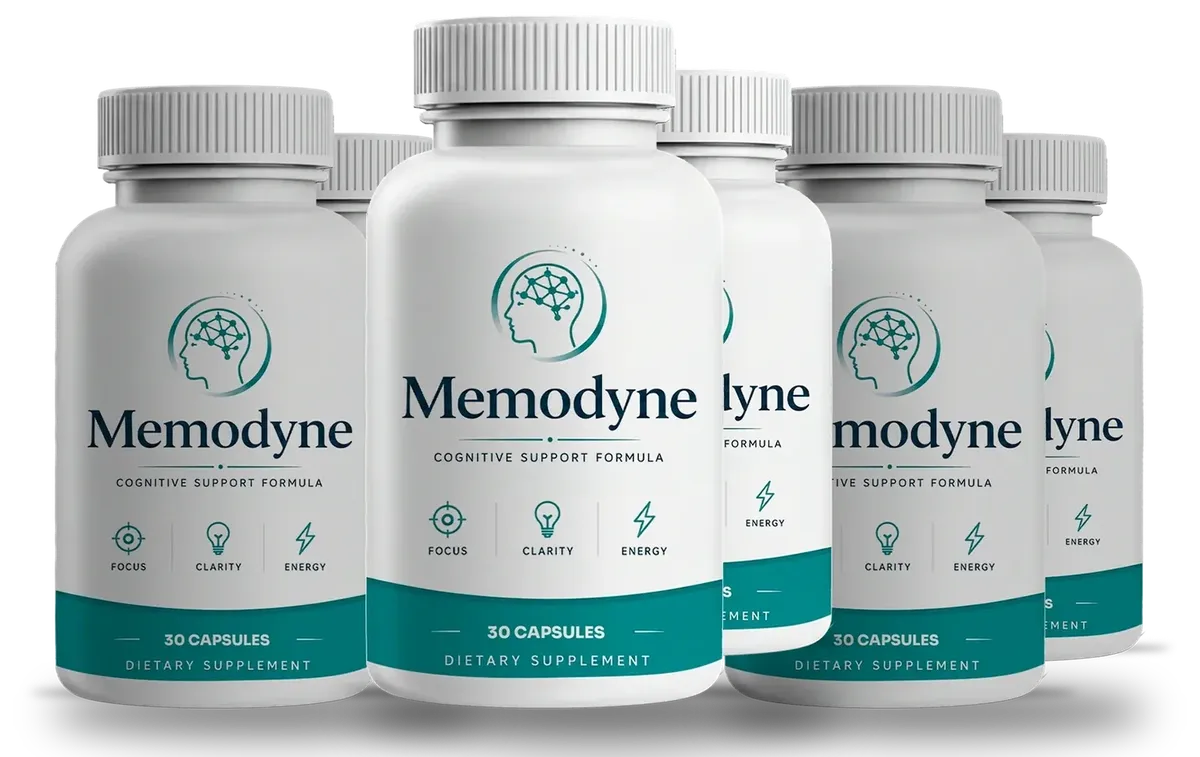
How to Read a Memory Supplement Label: 7 Steps With Memodyne as the Example
Quick answerRead a supplement label from the top of the panel down. Check the serving size, each ingredient and its amount, the Daily Value column, any blend, the salt forms, the other ingredients and the cautions, then find the company name. Memodyne's panel makes a good practice sheet because every line carries a number.
What are the key facts about reading this label?
Key facts
- One serving is one capsule, and a bottle holds 30 servings.
- The panel lists seven lines. Five are amino acids, which add up to 640 mg per capsule.
- Only niacin (47%) and calcium (1.5%) have a Daily Value. The other five lines show a dagger, which means Daily Value not established.
- There is no proprietary blend. Every line has its own amount.
- The brand's own ingredient list names six lines. The label prints a seventh, beta alanine at 40 mg. The label is the version that counts.
- The label names Gex Corporation LLP of Ogden, Utah as distributor and carries the FDA statement.
Why read the label before you read the ad?
An ad is written to sell. A Supplement Facts panel is written to meet a rule. Federal regulations require the panel to list each dietary ingredient with its amount per serving (21 CFR 101.36). That makes the panel the most reliable part of a bottle, and the easiest to check in your kitchen.
The steps below follow the panel from top to bottom. We use the Memodyne label because it is short and every line has a number. You can use the same steps on any memory, focus or brain supplement.
What are the 7 steps?
- 01
Find the serving size
How many capsules make one serving?
- 02
Read each amount
Is every ingredient given a number?
- 03
Check the Daily Value column
A percentage, or a dagger?
- 04
Look for a blend
One total for a group of names?
- 05
Read the salt forms
What part of the weight is the carrier?
- 06
Read the small print
Other ingredients, cautions, seal warning.
- 07
Find the company
Who is named, and where?
What does the Memodyne panel say?
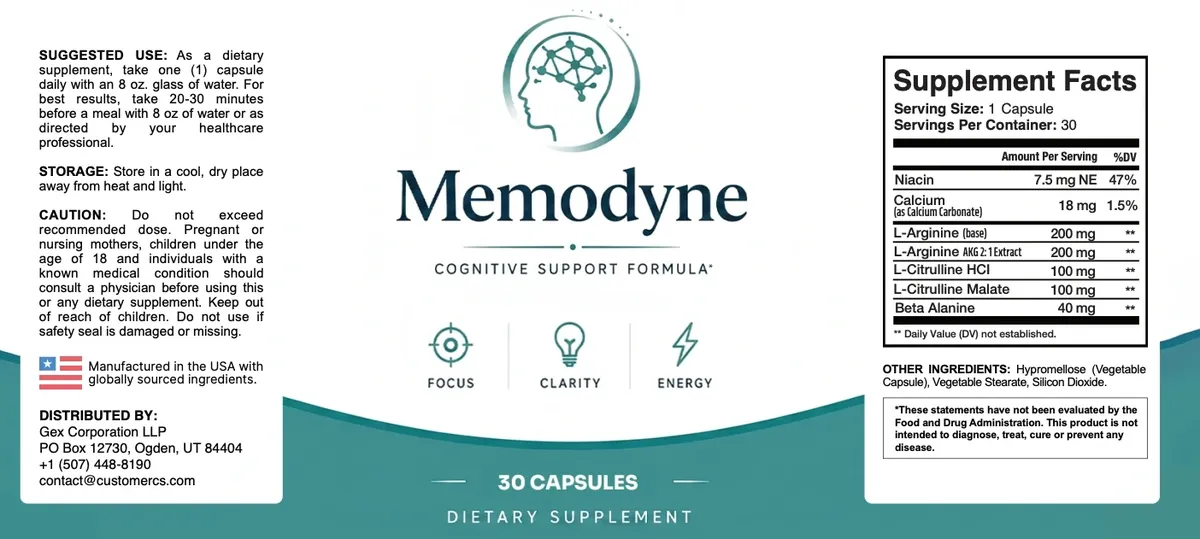
Here is the panel as printed. One serving is one capsule, and the bottle holds 30 servings.
| Label line | Amount | Daily Value |
|---|---|---|
| Niacin | 7.5 mg NE | 47% |
| Calcium (as calcium carbonate) | 18 mg | 1.5% |
| L-Arginine (base) | 200 mg | Not established |
| L-Arginine AKG 2:1 Extract | 200 mg | Not established |
| L-Citrulline HCl | 100 mg | Not established |
| L-Citrulline Malate | 100 mg | Not established |
| Beta Alanine | 40 mg | Not established |
Other ingredients: hypromellose (a vegetable capsule), vegetable stearate and silicon dioxide. The directions say to take one capsule daily with an 8 oz glass of water, ideally 20-30 minutes before a meal.
How do you read the serving size and the amounts?
Start with the serving size. If a label says two capsules, every number below it is for two. A shopper who compares a one-capsule product with a two-capsule product on raw numbers will get the wrong answer.
Then read the amounts. A good panel gives each ingredient its own figure in milligrams or micrograms. Memodyne does. Add the five amino acid lines and you get 640 mg, so you can see how much of the capsule is the active material.
What does the Daily Value column mean?
The percentage tells you how much of a day's reference amount one serving gives. Niacin at 7.5 mg NE shows 47%, which fits with adults needing 14 to 16 mg NE a day (NIH ODS, Niacin). Calcium at 18 mg shows 1.5%, because adults need 1,000 to 1,200 mg a day (NIH ODS, Calcium).
The dagger is not a warning. It means no Daily Value has been set, as is the case for amino acids. It also means the label gives you no scale, so you must find one yourself, such as the doses used in studies.
How do you spot a proprietary blend?
Look for a name followed by one total and a list of ingredients under it, such as “Brain Blend 500 mg” (a made-up example). The maker may put most of the weight in the cheapest item, and you cannot check. Memodyne has no such line.
Why this matters
Without separate amounts you cannot compare a product with a study, with another label or with your doctor's advice. A blend does not make a product bad, but it removes your ability to judge it.
What are salt forms, and why do they matter?
Many amino acids are sold bound to another molecule. The Memodyne label lists arginine as base and as AKG, and citrulline as HCl and malate. The extra part, alpha-ketoglutarate, hydrochloride or malic acid, adds weight. So 100 mg of citrulline HCl holds less than 100 mg of pure citrulline.
That does not make the forms wrong. It means the printed number is the weight of the whole ingredient, not of the amino acid alone. When you compare doses with a study, remember that small difference.
What belongs to the small print?
Read the other ingredients and the caution panel. Memodyne's caution says not to exceed the recommended dose, and it names pregnant or nursing mothers, children under 18 and people with a known medical condition as groups who should consult a physician first. It also says to keep the bottle out of reach of children and not to use it if the safety seal is damaged or missing.
Add your own cautions to the label's. Arginine and citrulline may lower blood pressure and add to blood pressure drugs, nitrates and ED pills (Mayo Clinic, L-arginine). If you take any of those, the printed caution is only the start of the conversation with your doctor.
How do you check the company and the FDA statement?
Find the name and address. Memodyne's label names Gex Corporation LLP, PO Box 12730, Ogden, UT 84404, as distributor and says the product was manufactured in the USA with globally sourced ingredients. It does not name the factory.
Then find the statement beside the asterisk on the front: these statements have not been evaluated by the Food and Drug Administration, and the product is not intended to diagnose, treat, cure or prevent any disease. The FDA does not approve dietary supplements before sale (FDA, Q&A on Dietary Supplements), so a label cannot carry an approval.
What does a clean label still not tell you?
It tells you what is in the capsule. It does not tell you whether the capsule works. No study of Memodyne has been published, and its doses are small next to the doses in research. A tidy panel is a floor for trust, not a ceiling.
Frequently asked questions
What should I look for on a memory supplement label?
The serving size, each ingredient with its own amount, the Daily Value where one exists, the other ingredients, the cautions and the company name and address.
What is a proprietary blend?
It is one total weight for a group of ingredients, without the amount of each. You cannot tell how much of any one you are getting. Memodyne has no blend.
What does the dagger mean on a supplement label?
It marks a line with no Daily Value established. Amino acids such as arginine, citrulline and beta-alanine carry it on the Memodyne label.
Why does the Memodyne label list two forms of arginine?
One is plain base and the other is bound to alpha-ketoglutarate (AKG). Each is printed at 200 mg, so the total is 400 mg of listed arginine.
Does the Memodyne label list every ingredient?
It lists seven lines, plus the other ingredients. The brand's own text names only six, so the label is the version that counts.
Does a good label mean the supplement works?
No. A good label means you can see what is inside. It says nothing about results, and no study of Memodyne has been published.
Our view
Our view is that label reading is the cheapest skill a supplement buyer can learn. It takes minutes and it works on any brand. Memodyne gives you a clean sheet to practice on, with numbers on every line and no blend.
Keep a photo of the panel on your phone. Show it to your pharmacist along with your medicine list, and let that conversation, not the front of the bottle, decide whether it is right for you.
Last updated
Label read? Then see the pack options
Seven printed lines, one capsule a day and a 60-day guarantee shown on the sales page. Ask your doctor first if you take blood pressure or heart medicine.
We earn money when you buy through our links. The price you see at checkout is the one that counts.